top of page

Auto-Matons,

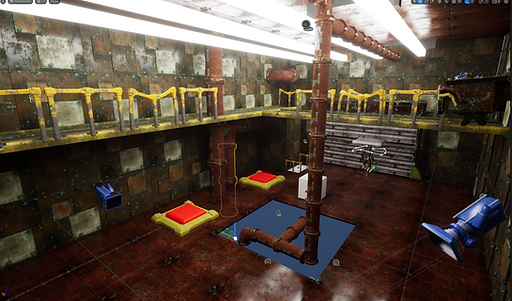
a third-person orthographic view puzzle game, stars two robots making their way through a ruined factory in a game of self-discovery and purpose. 

I worked on Auto-Matons as an Environmental 3D Modeler, helping flesh out the world through prop design. This was my first time working in a team on a game in my DES353-Launch Title Module, where we spent 13 weeks creating a game from start to shipping. It was my job to make sure that the Environment told a convincing story of a old, overgrown factory. 
Concept Art

When working in a large team, extensive concept art will help the team work together and stay on track visually and thematically. I worked as a character concept artist for a while, before moving on to duties as an Environment Artist.

My Models

rendershroom._(8)0000.png

A set of three red mushrooms, to push the abandoned and overgrown feel of the game. 

Red Mushrooms

rendershroom._(5)0000.png

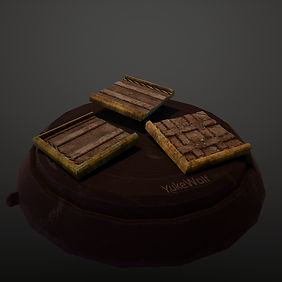
A modular set of walkways for the robots to traverse overhead areas.

Heavy Walkways

rendershroom._(9)0000.png

A set of four yellow mushrooms, to push add more color and bio-diversity to the game. 

Yellow Mushrooms

rendershroom._(4)0000.png

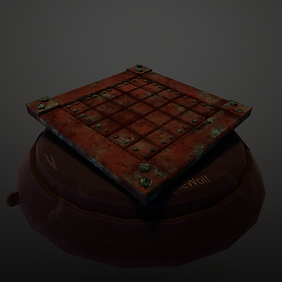
An oxidized floor panel to give environments a worn down feel, and be a building block for level layouts.

Textured Floor Panel

rendershroom._(7)0000.png

A security camera, operated by the automated system attempting to keep the robots inside the factory. 

Wall Camera

rendershroom._(6)0000.png

An oxidized floor panel to give environments a worn down feel, and be a building block for level layouts.

Smooth Floor Panel

rendershroom._(13)0000.jpeg

One of the first models in the game, three variants of moss are extensively used to fill out empty spaces in the room, and blend the organics into the factory scene.

Moss Clumps

rendershroom._(7)0000.png

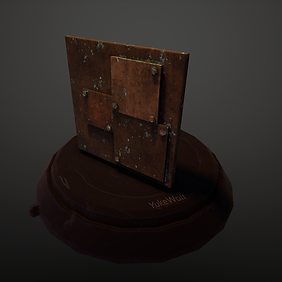
What good is a factory with no where to go? This sliding door acts as the passage are between the levels of the game, and is the primary objective in each room.

Sliding Factory Door

rendershroom._(10)0000.png

A simple oxidized metal wall to enclose the scene and be a canvas for wall decals and other props.

Smooth Wall Tile

rendershroom._(9)0000.png

A simple oxidized metal wall with metal panels riveted to it, to add variation in the environment.

Metal Plate Wall V1

rendershroom._(11)0000.png

A simple oxidized metal wall with metal panels riveted to it, to add variation in the environment.

Metal Plate Wall V2

rendershroom._(4)0000.png

A floor tile variation combining the smooth floor and textured floor to get a more detailed piece with lighter coloring.

Textured Floor Variant

rendershroom._(2)0000.png

A fully metal scene ended being too much detail for the eyes, so a neutral and lighter floor to be used helped immensely.

Concrete Floor Panel

rendershroom._(3)0000.png

Combining the concrete floor and the textured floor panels creates a textured concrete floor, for added scene variation.

Textured Floor Variant

Box_Icon.png

Vertex Painting

Vertex Painting is a technique that I had never used before this project. It allowed for us to build levels with more uniqueness, and allowed the modular assets I had created to be painted with overgrown moss, giving a break from the symmetry everywhere. It took a while to learn, but works wonders once I got it implemented. 

Post-Processing

While the props all looked good individually, I wanted our game to really feel cohesive and fit together in one world. Using assets from the Unreal Store, I put together this cel-shading post processing material, which we applied to everything to really make the elements pop. It's a subtle change in this scene, but helps define the shapes in the darkened environment. 

Stylized Post Process Materials

atomdev - Mar 11, 2022

chars.png
charlined.png

Support Me!

Contact Me!

About Me!

Lucas Wolf

Powered and secured by Wix

Feel free to contact me to discuss a possible project, or learn more about my work!

Support Me!

Contact Me!

About Me!

bottom of page